Tampilkan postingan dengan label Destroyer. Tampilkan semua postingan

Lockheed Martin’s Aegis Computer Program Development Approved by U.S. Navy for Australian Warfare Destroyer

22 Mei 2012

Hobart class Air Warfare Destroyer (image : MConrads)

MOORESTOWN, NJ –Lockheed Martin [NYSE: LMT] has completed computer program development and testing for the HOBART class Air Warfare Destroyer (AWD), the Royal Australian Navy’s Aegis-equipped ships. The computer programs have been approved by the U.S. Navy.

Tests were conducted over a two-week period at the Navy's land-based test facility, the Vice Admiral James H. Doyle Combat Systems Engineering Development Site in New Jersey.

"The Aegis Weapon System enables navies around the world to protect their citizens and their nations from continuously evolving threats,” said Doug Wilhelm, director of international Aegis programs for Lockheed Martin’s Mission Systems & Sensors business. “We look forward to working with the U.S and allied navies to continue to provide proven anti-air warfare capability on a global scale.”

The HOBART class will be capable of simultaneous operations in a multi-warfare environment, including anti-air, anti-surface, anti-submarine and naval gunfire support roles.

Lockheed Martin is a leader in combat systems integration and the development of integrated air and missile defense systems and technologies. Manufacturing work for this program will occur in Moorestown, N.J.

In addition to the U.S. and Australian navies, Aegis is also the weapon system for the navies of Japan, Norway, the Republic of Korea and Spain. The 100 Aegis-equipped ships in service around the globe have more than 1,250 years of at-sea operational experience and have launched more than 3,800 missiles in tests and real-world operations.

Headquartered in Bethesda, Md., Lockheed Martin is a global security and aerospace company that employs about 123,000 people worldwide and is principally engaged in the research, design, development, manufacture, integration and sustainment of advanced technology systems, products and services. The Corporation's net sales for 2011 were $46.5 billion.

State-of-the-Art Radars Delivered for AWDs

24 April 2012

Northrop Grumman AN/SPQ-9 Surface Surveillance and Tracking Radar, is a track-while-scan radar used with the MK-86 Gunfire Control system on surface combatants. It detects sea skimming missiles at the horizon even in heavy clutter while simultaneously providing detection and tracking of surface targets and beacon responses. (photo : Armybase)

Minister for Defence Materiel Jason Clare today announced the arrival in Adelaide of the first of three state of the art horizon-search radars for the Hobart Class Air Warfare Destroyers (AWDs).
“The AN/SPQ-9B radar is located on the main mast of the destroyers and can track over 200 radar contacts simultaneously with a high level of accuracy”, Mr Clare said.
“It will be used to search and track targets immediately above the sea surface, such as low-flying aircraft, unmanned aerial vehicles and missiles.
“The Royal Australian Navy is the first Navy outside of  the United States to receive the radar which is manufactured by US company Northrop Grumman.
“It was purchased by the Australian Government through the United States Foreign Military Sales program at a cost of around $10 million each.”
“This is an important milestone in the AWD Project, which involves the construction of three new warships.
“The new ships are based on a proven design from the Spanish Navy.  When complete, the AWD will be one of the most capable warships of its size in the world.
“Each AWD will have anti-air, anti-submarine and anti-surface warfare capability as well as the ability to embark a helicopter at sea.
Construction of the AWDs involves the fabrication of 90 separate steel blocks, 30 for each ship, as well as three additional sonar blocks at a number of shipyards in Australia and overseas.
These blocks will be brought together by ASC at the South Australian Government’s Common User Facility in Adelaide where the ships are being assembled.
5 blocks have already been delivered from Williamstown shipyard in Melbourne, with a further 12 planned to be delivered this year from shipyards in Williamstown, Newcastle and Spain including a sonar block for HMAS Hobart.
So far this year the gun software and gun weapon systems have been received, and the combat system is currently being tested in the United States.
By the end of 2013, 34 more blocks are due to be completed, work will have begun on the third ship HMAS Sydney and trials of crew training will have commenced.

Allocation of Block Construction Work for the Third Air Warfare Destroyer

09 Maret 2012

Air Warfare Destroyer for Royal Australian Navy (image : Aus DoD)

The Minister for Defence Stephen Smith and the Minister for Defence Materiel Jason Clare today announced the allocation of construction work for the third ship of the $8 billion Air Warfare Destroyer (AWD) Project.

The allocation of block construction work for ship three is as follows:

• Forgacs (Newcastle) – 15 blocks;
• ASC (Adelaide) – eight blocks;
• Navantia (Spain) – five blocks; and
• BAE Systems (Melbourne) – two blocks.

This means the four shipyards will construct the same blocks for ship three that they are constructing for ship two. The construction arrangements for block structure and block pre-outfit are:

• Ship 1: BAE Systems 7, Forgacs 14, ASC 9
• Ship 2: BAE Systems 2, Forgacs 15, ASC 8, Navantia 5
• Ship 3: BAE Systems 2, Forgacs 15, ASC 8, Navantia 5

Getting the same shipyards to build the same blocks for ships two and three will enable the AWD Project to take advantage of lessons the shipyards have learnt and the experience they have gained from building the same blocks.

The AWD project involves the construction of 90 separate steel blocks being built at four shipyards in Adelaide (ASC), Melbourne (BAE Systems), Newcastle (Forgacs) and Spain (Navantia) as well as the three sonar block assemblies being built in Spain and the United Kingdom.

In May last year the Government announced the reallocation of 18 blocks for AWD Ships one and two. Thirteen blocks were divided between Forgacs, ASC and BAE with five allocated to Navantia.
The reallocation of work for ship three means that overall division of block construction across the project is:

• Forgacs – 44 blocks;
• ASC – 25 blocks;
• BAE Systems – 11 blocks; and
• Navantia – 10 blocks.

BAE Systems Ships More AWD Blocks to Adelaide

03 Maret 2012

Total number of blocks delivered by BAE to ASC to five (photo : AusAWD)

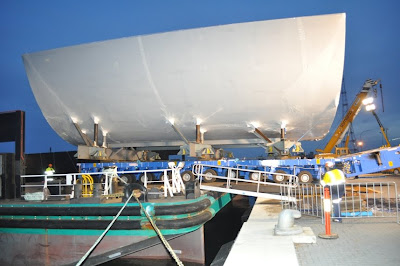
Two more keel blocks constructed by BAE Systems for the Air Warfare Destroyer (AWD) program have been shipped to the ASC facility in Osborne South Australia.

Each of these blocks weighs approximately 100 tonnes and are approximately 14 metres long, 17 metres wide and 5 metres high. Both of the blocks left BAE Systems Williamstown shipyard on Monday by barge.


BAE Systems Director of Maritime, Bill Saltzer, said the delivery brought the total number of blocks delivered to ASC to five (the first three having been delivered during 2011) and marked another significant milestone achieved on this important project.


“Construction of another six blocks is already underway in Williamstown, with two more to be delivered in a couple of months and the other four scheduled for completion later this year,” he said.

Mr Saltzer congratulated the BAE Systems staff for achieving further success on this project.

The $8 billion AWD project comprises three ships and will provide the Royal Australian Navy with one of the world’s most capable multi-mission warships. ASC is a member of the Air Warfare Destroyer Alliance which is responsible for delivering the ships to Navy. The five blocks now delivered to ASC will form a large part of the keel of the first ship HMAS Hobart.


Babcock Tests AWD Torpedo Launcher

03 Februari 2012

Mk32 torpedo launcher (photo : Seaforce)

Assembly of the Mk32 Mod 9 torpedo launchers for the Hobart Class Air Warfare Destroyers is now underway at Babcock's Techport Australia premises, marking an important milestone in the contract. Babcock Pty Ltd, part of Babcock International Group, was awarded the contract in December 2008 by Raytheon Australia Pty Ltd, on behalf of the Air Warfare Destroyer (AWD) Alliance.

Two Mk32 Mod 9 torpedo launcher assemblies will be mounted in magazine compartments, port and starboard, on each of the three Hobart class AWDs. Originally designed for the US Navy, the Mod 9 launcher is a twin barrelled variant of the Mk32 launchers currently in operation on Anzac and FFG frigates in Australia and will be modified to discharge Eurotorp MU90 torpedoes.


Babcock engineers and technicians are now commencing assembly of the launchers, which will take around seven months for all six launchers (three ship sets), and will be followed by Factory Acceptance Testing (FAT) of each set at Babcock's newly developed facility at Techport, South Australia. FAT will involve safety and interlock checks and the measurement of additional system parameters during the discharge of a dummy weapon from the launchers into a specially designed rig.

Under the contract to date, the first phase has seen Babcock working closely with the US Naval Underwater Weapons Centre at Rhode Island, and transfer of a technical data pack to Australia under a license granted by the US Department of State, in accordance with appropriate US International Traffic in Arms Regulations (ITAR). The data pack provides the basis for the procurement, manufacture, assembly and test of the equipment in Australia. Babcock now has the system and processes in place to handle ITAR controlled design information and procure ITAR controlled hardware through its US network.

Manufacture of component parts, including barrels, quadrants, breech locking rings, and air charging panels, as well as a number of major sub-assemblies, has also been on-going during the first phase of the contract. While some equipment has been sourced from specialist international suppliers, all other work is being carried out in Australia, representing around 60% of the contract value.


"Having the component parts and sub-assemblies arrive at our Techport Australia site, and starting the assembly process, marks an exciting and important milestone in this contract," Babcock director Pat Donovan comments. "Delivery of the completed launchers is on track against our project schedule, and ahead of the customer's required delivery date of September 2011 for the first ship set."

HS Kimon/ΚΙΜΩΝ (D218)

HS Kimon/ΚΙΜΩΝ (D218) Ex-USN USS Semmes (DDG 18) Commissioned on 12/10/1962. The Adams class destroyers are currently the only ships in the Hellenic Navy with the ability to carry the SM-1 missile. This missile of course is a very powerful weapon system that provides added range to the anti-aircraft 'umbrella' around a fleet. (Photo: Hellenic Navy)

HS Kimon/ΚΙΜΩΝ (D218)

HS Kimon/ΚΙΜΩΝ (D218) Ex-USN USS Semmes (DDG 18) Commissioned on 12/10/1962. The Adams class destroyers are currently the only ships in the Hellenic Navy with the ability to carry the SM-1 missile. This missile of course is a very powerful weapon system that provides added range to the anti-aircraft 'umbrella' around a fleet. (Photo: Hellenic Navy)

USS Cape St. George (CG-71)

The Ticonderoga-class guided-missile cruiser USS Cape St. George is guided out of port by a tugboat. Cape St. George recently completed a scheduled port visit to Thailand to strengthen ties between the two partner nations. (U.S. Navy photo by MC3 Adam Randolph)

JS Hyuga (DDH 181)

The Japan Maritime Self-Defense Force helicopter destroyer JS Hyuga (DDH 181) prepares to turn from a formation of U.S. Navy and Japan Maritime Self-Defense Force ships during Annual Exercise 2011. Annual Exercise is a bi-lateral field training exercise designed to practice and evaluate the coordination procedures and interoperability elements required to respond to the defense of Japan and the Asia-Pacific region. (U.S. Navy photo by Mass Communication Specialist 2nd Class Adam K. Thomas/Released)

JS Kurama (DDH 144)

The Japan Maritime Self-Defense Force helicopter destroyer JS Kurama (DDH 144) test fires chafe as part of the integrated maritime exercise Koa Kai. Kurama is participating in Koa Kai with the guided-missile destroyers USS O'Kane (DDG 77) and USS Chafee (DDG 90), the guided-missile frigate USS Crommelin (FFG 37), and the Military Sealift Command dry cargo and ammunition ship USNS Washington Chambers (T-AKE 11) to prepare independent deployers in multiple warfare areas and provide training in a multi-ship environment. (U.S. Navy photo by Mass Communication Specialist 2nd Class Daniel Barker/Released)

JS Kurama (DDH 144)

The Japan Maritime Self-Defense Force (JMSDF) helicopter destroyer JS Kurama (DDH 144) departs Joint Base Pearl Harbor-Hickam to be part of exercise Koa Kai 12-1. Koa Kai 12-1 is an integrated maritime exercise to prepare independent deployers in multiple warfare areas, while also providing training in a multi-ship environment. (U.S. Navy photo by Mass Communication Specialist 2nd Class Mark Logico/Released)

PNS Shahjahan (D186)

The Pakistani navy destroyer PNS Shahjahan (D 186) transits the Arabian Sea during a division tactics exercise. (U.S. Navy photo by Mass Communication Specialist 3rd Class Deven B. King/Released)

PNS Shahjahan (D186)

The Pakistani navy destroyer PNS Shahjahan (D 186), left, and the guided-missile cruiser USS Mobile Bay (CG 53) transit the Arabian Sea during a division tactics exercise. Mobile Bay is in the U.S. 5th Fleet area of responsibility conducting maritime security operations and theater security cooperation efforts. (U.S. Navy photo by Mass Communication Specialist 3rd Class Deven B. King/Released)

PNS Shahjahan (D186)

The Pakistani navy destroyer PNS Shahjahan (D 186), left, and the guided-missile cruiser USS Mobile Bay (CG 53) transit the Arabian Sea during a division tactics exercise. Mobile Bay is in the U.S. 5th Fleet area of responsibility conducting maritime security operations and theater security cooperation efforts. (U.S. Navy photo by Mass Communication Specialist 3rd Class Deven B. King/Released)

PNS Shahjahan (D186)

The Pakistani navy destroyer PNS Shahjahan (D 186), left, and the guided-missile cruiser USS Mobile Bay (CG 53) transit the Arabian Sea during a division tactics exercise. Mobile Bay is in the U.S. 5th Fleet area of responsibility conducting maritime security operations and theater security cooperation efforts. (U.S. Navy photo by Mass Communication Specialist 3rd Class Deven B. King/Released)

Navantia Begins Construction Second Australian AWD

18 Oktober 2011

The five blocks to be built in Ferrol and Fene (image : Navantia)

On 18 October, Navantia-Ferrol Fene has begun the construction of five blocks for the second Air Warfare Destroyer (AWD) of the Royal Australian Navy.

Such a start was made on the premises of Aceros de Ferrol, with cut sheet for the block number 109.

The five blocks to be built will be the 109, 103 and 101, to be held in the premises of Ferrol, and 107 and 105 to be made in Fene facilities. Previously block 603 for the dome area of the ship, was also built at Fene.

It is expected that the contract for the execution of these five blocks, which was approved by the Australian Government last May, be signed shortly, once the scope of all technical requirements have been agreed. The realization of these blocks will be a workload of 410,000 man-hours.

In 2007, Navantia won the contract to design and support of three AWD, based on the proposed F-105 Frigate of the Spanish Armada, as well as certain equipment and systems for these vessels.

(Navantia)

Qingdao (DDG 113)

The Chinese Navy destroyer Qingdao (DDG 113) transit through the Pearl Harbor channel while being escorted by a harbor patrol boat as it arrives for a routine port visit. Two ships representing China’s Navy, the destroyer Qingdao (DDG 113) and the oiler Hongzehu (AOR 881) arrived in Pearl Harbor. During their visit, China’s Sailors will have the opportunity to interact with their U.S. counterparts and experience the unique culture of Hawaii. (U.S. Navy photo by Mass Communication Specialist 3rd Class Ben A. Gonzales)

USS Cushing (DD 985)

The Spruance Class destroyer USS Cushing (DD 985) returns to her forward deployed operating base, Commander, Fleet Activities Yokosuka, Japan, after a regularly scheduled underway period. (U.S. Navy photo by Photographer's Mate 1st Class Alan Warner)

USS Cushing (DD 985)

The Spruance Class destroyer USS Cushing (DD 985) returns to her forward deployed operating base, Commander, Fleet Activities Yokosuka, Japan, after a regularly scheduled underway period. (U.S. Navy photo by Photographer's Mate 1st Class Alan Warner)

USS Cushing (DD 985)

The Harbor Tug Massapequa (YTB 807) assists the Spruance-class destroyer USS Cushing (DD 985) as it returns to its forward deployed operating base at Commander, Fleet Activities Yokosuka, Japan, after a regularly scheduled underway period. (U.S. Navy photo by Photographer's Mate 1st Class Alan Warner)