Tampilkan postingan dengan label CHINA. Tampilkan semua postingan

Indonesia Kaji Industri Pertahanan Elektronika dengan China


08 Mei 2012


Peralatan elektronika pada Kapal Cepat Rudal TNI (photo : Audrey)


Beijing (ANTARA News) - Indonesia hingga kini masih mengkaji kerja sama sistem industri pertahanan elektronika yang ditawarkan China yakni Defence Electonics Complex of Indonesia (DECI). 


"Hingga kini masih terus dikaji dan dibahas di Kementerian Pertahanan dan industri pertahanan nasional terkait," kata Atase Pertahanan Kedutaan Besar RI untuk China dan Mongolia, Suryamargono ketika dikonfirmasi di Beijing, Selasa.


Ia mengatakan tawaran kerja sama itu meliputi berbagai kegiatan antara lain perancangan dan pengembangan fabrikasi sistem unit, modul serta perakitan peralatan elektronika seperti radar,peperangan elekronika dan lainnya.


"Kerja sama itu akan dilakukan dalam tiga tahapan, namun semua ini masih dikaji dalam berbagai aspek," kata Suryamargono menegaskan.


Berdasar laporan yang diterima ANTARA industri elektronika tidak saja berperan besar bagi industri pertahanan secara keseluruhan, namun juga pertumbuhan ekonomi secara umum.


Produksi elektronika global mencapai Rp13 ribu triliun, dari jumlah itu Asia Pasifik merupakan kontributor terbesar yakni sekitar 37 persen. Namun, dari 37 persen tersebut Indonesia baru memberikan kontribusi sekitar satu persen.


Kerja sama industri pertahanan elektronika itu ditawarkan salah satu grup industri pertahanan China yakni China Electronics technology Group Corporation (CETC).


Kerja sama serupa telah dilakukan China melalui CETC dengan Pakistan dalam program National Electronic Complex of Paksitan (NECOP). 


Terkait Indonesia, CETC sebelumnya telah memiliki kerja sama dengan kementerian Pertahanan dan TNI terutama TNI Angkatan Laut dalam program Kapal Cepat Rudal (KCR).


(Antara)

Thailand-China to Jointly Develop MLRS with a Guidance System


29 April 2012


In an earlier joint deal, Thailandand Chinadeveloped the DTI-1 system, DTI-1G [Guided]" will be more accurate and have a greater range than existing systems (photo : MThaiNews)

Top brass Chinavisit secures joint missile deal

BEIJING : Thailand and China have agreed to jointly develop multiple rocket launchers with a guidance system as part of a move to strengthen military ties.

The two sides reached the agreement during a visit to China by the Thai military top brass in what was described by Defence Minister Sukumpol Suwanatat as a call by "the whole family" to Chinawhich is "our close relative".

It is the first time in 15 years that a defence minister has led all key military leaders ranging from the defence permanent secretary, supreme commander and armed forces chiefs to meet Chinese senior military officers, led by National Defence Minister Gen Liang Guanglie.

Under the new agreement, the Thai Defence Technology Institute will work with China to develop new multiple rocket launchers called "DTI-1G [Guided]" which will be more accurate and have a greater range than existing systems, said ACM Sukumpol after the meeting.

Multiple rocket launchers are known for their devastating capabilities and ability to deliver a large amount of ordinance simultaneously, but are not recognised for precision because they are not usually equipped with a guidance system.

In an earlier joint deal, Thailandand Chinadeveloped the DTI-1 system, which had a range of between 60 and 180km, but it lacked accuracy.

The new DTI-1G project will last three years and will be funded under a 1.5-billion-baht budget, ACM Sukumpol said.

Gen Liang also told the delegation that if Thailand wants to buy weapons from China, it will be willing to sell them at "friendly prices", ACM Sukumpol quoted Gen Liang as saying."The price of Chinese weaponry has increased greatly recently. Arms are not as cheap as before so we will have to consider this carefully," ACM Sukumpol said.

As well as technological cooperation, the Thai and Chinese defence ministries have also agreed to hold a joint military exercise involving their air forces for the first time.

"We will need to discuss more details of this because Thailand and China have different military doctrines in the aviation area," ACM Sukumpol said.

So far the two countries have held joint military drills involving the army's special warfare units and the navy's marine corps.

China's Defense Budget to Grow 11.2 pct in 2012

05 Maret 2012

Expected defence budget in 2015 (image : AFP)

BEIJING, (Xinhua) -- China said Sunday it plans to raise its defense budget by 11.2 percent to 670 billion yuan (106.4 billion U.S. dollars) in 2012.

This year's draft defense budget is 67.6 billion yuan more than the defense expenditure of 2011, said Li Zhaoxing, spokesman for the annual session of China's national legislature.

"The Chinese government follows the principle of coordinating defense development with economic development. It sets the country's defense spending according to the requirements of national defense and the level of economic development," Li told a press conference.

The former foreign minister said the growth of China's defense expenditure is "reasonable and appropriate."

"The Chinese government has maintained reasonable and appropriate growth in defense spending on the strength of rapid economic and social development and the steady increase of fiscal revenues," he said.

During the last three years since the outbreak of the international financial crisis, China's gross domestic product (GDP) and national fiscal expenditure showed year-on-year growth of 14.5 percent and 20.3 percent, respectively, but the country's defense expenditure only grew by 13 percent, according to Li.

He also noted that the share of defense spending in China's GDP dropped from 1.33 percent in 2008 to 1.28 percent in 2011, and that in China's fiscal expenditure dropped from 6.68 percent in 2008 to 5.53 percent in 2011.

China's national defense spending has always been maintained at a moderate and sufficient level, said Major General Luo Yuan, a researcher with the Chinese People's Liberation Army (PLA) Military Science Academy.

"Moderate" means China will not raise its military spending merely for the purpose of boosting scale, while "sufficient" means the spending has to meet necessary demand for national defense, said Luo.

Wen Bing, another researcher with the academy, said the moderate growth of China's defense budget reflects the composure of the Chinese government under the changing global strategic environment.

"In terms of defense spending, the Chinese government will not, as some foreign analysts suggest, make a drastic response to, or overreact to, the so-called 'worsening of global security'," Wen said.
China's military spending mainly comprises the living expenditures of servicepeople, expenses for training and maintenance, and spending on equipment, Li said at the press conference.

The costs for research, experimentation, procurement, repair, transport and storage of all weapons and equipment, including new types of weapons, are included in the defense budget that is published every year, the spokesman said.

"China is committed to the path of peaceful development and follows a national defense policy that is defensive in nature," Li said.

Compared to other major countries, China's military spending is low given its population of 1.3 billion, vast land area and long coastlines, Li said.

China's military spending is dwarfed by that of the United States, at 725 billion U.S. dollars, and its per capita figure is also far less than that of the U.S., Luo said.

While China's military spending amounted to 1.28 percent of its GDP in 2011, that of the United States, Britain and other countries all exceed 2 percent, said Li.

"The limited military strength of China is solely for safeguarding its national sovereignty and territorial integrity, and will not pose a threat to any country," said Li.

A report by INS Jane, a European think tank, said China's military expenditures will increase from 119.8 billion U.S. dollars in 2011 to 238.2 billion U.S. dollars in 2015.

"I don't know where the report cited those figures," Defense Ministry spokesman Geng Yansheng said at a regular press briefing in February, adding that China always stands for coordinated development between national defense and the economy.

China will not develop its military strength beyond national security demands and economic capability, and will not conduct an arms race with any country, Geng said.

Li said China is transparent not only with its defense figures, but also about the fact that everything China's defense and diplomatic personnel does is to maintain peace.

"We have made tremendous efforts together with all peace-loving countries and peoples of the world," he said.

By June last year, China had sent a total of 2,044 peace-keeping personnel to 12 peace-keeping zones around the world, and the Chinese navy has sent escort vessels to the Gulf of Aden and waters off the coast of Somalia to protect thousands of commercial vessels from China and other countries, according to Li.

The defense figures came one day before the annual session of the National People's Congress, which sets out government policy for the coming year.

Indonesia dan China Sepakati Alih Teknologi Rudal

21 Februari 2012

Menurut siaran pers resmi, kerja sama industri pertahanan tersebut terkait dengan produksi peluru kendali darat ke darat (ground to ground), darat ke udara (ground to air), serta udara ke darat (air to ground) untuk melengkapi arsenal persenjataan Indonesia (photo : Kaskus Militer)

RI China Produksi Bersama Peluru Kendali

JAKARTA - Pemerintah Republik Indonesia (RI) dan China sepakat memantapkan proses alih teknologi serangkaian produksi bersama peluru kendali C-705. Proses alih teknologi menjadi syarat utama dalam setiap pembelian alat utama sistem senjata (alutsista) dari mancanegara, termasuk peluru kendali dari China.

"Selain itu, kita juga telah menjajaki kerja sama produksi bersama rudal tersebut sebagai produk nasional," kata Kepala Pusat Komunikasi Publik Kementerian Pertahanan (Kemhan) Brigjen TNI Hartind Asrin, di Jakarta, Senin (20/2).

Rangkaian proses alih teknologi itu, antara lain ditandai dengan kunjungan Menteri Pertahanan (Menhan) Purnomo Yusgiantoro ke China Precision Machinery Import-Export Corporation (CPMEIC) yang menjadi pemegang proyek pengerjaan rudal C-705 yang akan dibeli TNI AL disertai proses alih teknologi.

Sebelumnya, kedua pemerintah telah menandatangani nota kesepahaman kerja sama teknis pertahanan kedua negara. Penandatanganan nota kesepahaman dilakukan Wakil Menhan Sjafrie Sjamsoeddin dan Kepala Badan Pengembangan Teknologi dan Industri Nasional Pertahanan China, Chen Qiufa.

Lima Poin

Nota kesepahaman itu mencakup lima poin. Pertama, pengadaan alutsista tertentu yang disepakati kedua pihak dalam kerangka G to G. Kedua, alih teknologi peralatan militer tertentu yang antara lain mencakup perakitan, pengujian, pemeliharaan, modifi kasi, up grade, dan pelatihan. Tiga poin lainnya adalah kerja sama produk peralatan militer tertentu, pengembangan bersama peralatan militer tertentu, serta pemasaran bersama di dalam dan di luar negara masing-masing. Selama di China, Menteri Pertahanan Purnomo Yusgiantoro melakukan kunjungan kehormatan kepada Wakil Perdana Menteri China Li Keqiang.

Menhan bersama pejabat lainnya berkunjung ke China pada 19-21 Februari dalam rangka memenuhi undangan Menteri Pertahanan China Jenderal Liang Guanglie. "Segera setelah mendarat di Beijing, pada hari pertama, Menhan melakukan kunjungan, menggelar diskusi, serta meninjau dua kompleks industri pertahanan China yang terkait dengan produksi peluru kendali yaitu China Precision Machinery Import-Export Corporation (CPMIEC) dan Aerospace Long March International Trade & co., Ltd. (ALIT)," tulis siaran pers Kedutaan Besar Republik Indonesia di Beijing.

Di akhir pertemuan tersebut dicapai kesepakatan untuk kerja sama industri pertahanan yang meliputi alih teknologi yang diharapkan menguntungkan kedua negara.

Delegasi Kemhan hari ini dijadwalkan melakukan pertemuan dan perundingan dengan Menhan China Jenderal Liang Guanglie, kemudian bertukar pikiran dengan salah satu lembaga riset/produksi industri pertahanan terkemuka lainnya di China yaitu State Administration for Science, technology and Industry for National Defence (SASTIND). Pertemuan lain yang merupakan bagian dari kunjungan itu adalah pertemuan dengan Wakil Kepala Komite Sentral Militer China Jenderal Guo Boxiong yang merupakan orang pertama di Angkatan Perang China (PLA).

China's Defence Budget to Double to $238bn by 2015

15 Februari 2012

China J-10 aircraft (photo : worldaffairboard)

CHINA'S booming economy means its defence budget will double by 2015 to $238.2 billion, about four times the size of its nearest rival, Japan, according to a report released yesterday by global defence information provider IHS Janes.

The economies of Japan and India, whose defence budgets are the second- and third-largest in the Asia-Pacific region, have both been flagged "at risk", a grading carrying serious implications for their respective defence requirements, the report warned.

It tracked the economies of the Asia-Pacific's 13 biggest defence spenders, including Australia and its Anzac partner New Zealand's whose economy was also graded "at risk".

The report reinforces regional concerns about China's military build-up.

But it also raises questions about other states in the region keen to modernise ageing arsenals.

"This isn't a three-horse race (China, India and Japan). Taiwan's rate of investment means it has overtaken Singapore in terms of defence spend by 2015, while Vietnam and Indonesia are also forecast to increase defence spending at a rate that exceeds GDP growth.

"China's rise is not the only motivator. There are a number of lingering security issues, driven by competition for untapped natural resources, that are prompting many states to increase their defence to GDP (gross domestic product) ratio," said IHS Janes senior analyst, Paul Burton.

Both Japan and India are likely to rein in defence spending due to economic challenges.

Japan's government debt and investment needed after Fukushima (earthquake) will impact on defenece spending, the report forecast.

While firm economic growth is predicted in Australia from 2012-15, the federal government's promise to set real defence growth at 3 per cent raises doubts as to whether the defence budget will be large enough to meet demands for an ambitious equipment program.

Australia, the region's fifth-biggest military purchaser, spent $23.6 billion on defence last year, a figure expected to rise to $27.5 billion by 2015.

On New Zealand, IHS-Janes warned a significant deterioration in medium-term public finances since 2009 combined with post-disaster reconstruction following the Christchurch earthquake would constrain the government's ability to deliver on its 2011 defence capability plan.

The economy of New Zealand, the Asia-Pacific's 13th-biggest defence spender's remains "at risk".

Qingdao (DDG 113)

The Chinese Navy destroyer Qingdao (DDG 113) transit through the Pearl Harbor channel while being escorted by a harbor patrol boat as it arrives for a routine port visit. Two ships representing China’s Navy, the destroyer Qingdao (DDG 113) and the oiler Hongzehu (AOR 881) arrived in Pearl Harbor. During their visit, China’s Sailors will have the opportunity to interact with their U.S. counterparts and experience the unique culture of Hawaii. (U.S. Navy photo by Mass Communication Specialist 3rd Class Ben A. Gonzales)

China’s J-20 to be effective capability by 2018 - Pentagon

27 Agustus 2011


Chengdu J-20 aircraft (photo : Sina)

A Pentagon report has highlighted major advances by the Chinese People's Liberation Army Air Force (PLAAF), with specific mention of the developmental Chengdu J-20 aircraft.

Washington believes the J-20 could achieve an "effective operational capability" by 2018, and suggests the aircraft's role is as not a fighter, but rather a long-range attack platform. It says engine technology is the main challenge China will face in developing the J-20.

The US Department of Defense's annual report to Congress, entitled "Military and Security Developments Involving the People's Republic of China," covers all aspects of China's defence modernisation.


"The J-20 will eventually give the People's Liberation Army Air Force a platform capable of long-range, penetrating strikes into complex air defense environments," said the report.

There has been debate in defence circles as to the exact role of the J-20. Some have speculated that it is intended as a direct rival to the Lockheed Martin F-35 Lightning IIfighter. Another popular theory indicates that it is designed specially for long-range attacks against American aircraft carriers and other targets.

One table in the report underlined the speed and scale of PLAAF modernisation over the last decade.


J-20 during flight test (photo : Highpants)

In 2000, around 2% of its platforms were considered modern, whereas today the number is 25%, with the force being filled out with types such as the Sukhoi Su-27 and Su-30, as well as the Chengdu J-10.

The report indicated that most of China's modernisation efforts are aimed squarely at being able to prevail in a conflict over Taiwan, which China views as a breakaway province.

China has a total of 1,680 fighter aircraft, of which 330 are stationed within range of Taiwan, where they are opposed by Taiwan's fighter fleet of just 388 aircraft. As for bombers and attack aircraft, 160 are within range of Taiwan, out of a total of 620.

"Currently, 490 aircraft could conduct combat operations against Taiwan without refueling," said the report. "This number could be significantly increased through any combination of aircraft forward deployment, decreased ordnance loads or altered mission profiles."

A war over Taiwan could draw in the USA. Recognising this, China has developed new capabilities tailored for an "anti-access" strategy, aimed at delaying or preventing American intervention.


(FlightGlobal)

Uji Coba Kapal Induk China Sukses

15 Agustus 2011


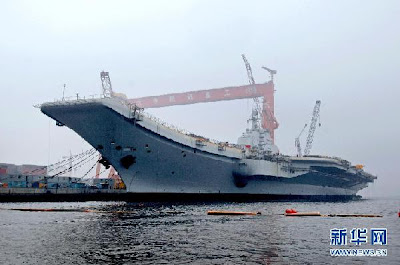
Kapal induk China saat uji coba (photo : Defencetalk)


BEIJING, KOMPAS.com - Kapal induk pertama China kembali ke pelabuhan setelah menyelesaikan dengan "mulus" uji coba yang dirancang untuk menguji kemampuan kapal itu, lapor kantor berita remsi Xinhua, Senin (15/8/2011).


Kapal sepanjang 300 meter itu merapat di pelabuhan Dalian di timur laut China, Minggu pagi, setelah uji coba selama lima hari. Uji coba itu telah memicu kekhawatiran internasional terkait perluasan jangkauan angkatan laut negara itu serta tujuan pengadaan peralatan militer semacam itu.


Uji coba kapal induk tersebut terjadi di tengah ketegangan terkait sejumlah sengketa wilayah maritim yang melibatkan China, terutama di Laut China Selatan. Kawasan Laut China Selata diyakini mengandung banyak minyak bumi dan gas alam dan diklaim oleh sejumlah negara.


Xinhua melaporkan, para pekerja pelabuhan menembakkan kembang api saat kapal itu, yang merupakan hasil rombakam atas kapal induk tua Soviet bernama Varyag, kembali ke pelabuhan. Xinhua menambahkan, kapal itu akan menjalani pengerjaan lebih lanjut dan pengujian.


"Uji coba yang dilakukan kapal induk itu pada pelayaran perdananya berjalan lancar," demikian kataXinhua. Tentara Pembebasan Rakyat China, militer aktif terbesar di dunia, sangat tertutup tentang program pertahanannya. Militer China mendapat manfaat dari anggaran dan belanja militer yang besar menyusul pertumbuhan ekonomi negara itu yang pesat. Awal tahun ini, China mengumumkan belanja militer naik 12,7 persen menjadi 601,1 miliar yuan (91,7 miliar dollar AS) pada tahun 2011.


Pada Januari terungkap, China mengembangkan jet tempur siluman pertama. Negara itu juga diketahui sedang mengerjakan rudal anti-balistik yang mampu menenggelamkan kapal angkatan laut AS yang paling kokoh.


Jepang baru-baru ini telah menyatakan keprihatinan terkait apa yang disebut "keburaman" anggaran militer China. Sementara Departemen Luar Negeri AS pekan lalu menyerukan kepada China untuk menjelaskan apa urgensinya negara itu punya sebuah kapal induk. "Telah merupakan bagian dari perhatian besar kami bahwa China tidak setransparan negara-negara lain," kata juru bicara Deplu AS, Victoria Nuland. "China tidak setransparan AS tentang anggaran militernya."


Beijing baru-baru ini hanya mengonfirmasi bahwa negara itu merombak kapal tua Soviet. Pihak China berulang kali menegaskan bahwa kapal induknya tidak untuk menimbulkan ancaman bagi negara tetangga dan akan digunakan terutama untuk tujuan pelatihan dan penelitian. Namun situs-situs berita yang dikelola kementerian pertahanan China memperlihatkan posisi yang berbeda empat hari lalu. Berita-berita dalam situs-situs itu menyatakan, kapal induk itu bisa digunakan menangani sengketa teritorial juga.


China's Refitted Aircraft Carrier Platform Sets Sail for First Sea Trial

10 Agustus 2011


File photo of China's refitted aircraft carrier. The aircraft carrier left its shipyard at Dalian Port in northeast Liaoning Province on Wednesday morning to start its first sea trial. Military sources said that the first sea trial was in line with schedual of the carrier's refitting project and would not take a long time. After returning from the sea trial, the aircraft carrier will continue refit and test work. (photo : Xinhua)


DALIAN, (Xinhua) -- China's refitted aircraft carrier platform left its shipyard at Dalian Port in northeast China's Liaoning Province on Wednesday morning to set sail for its first sea trial.

Military sources said that the trial is in line with the carrier's refitting schedule and will not take a long time. Refitting work will continue after the vessel has returned to the port.


The carrier was originally built by the former Soviet Union, which failed to complete the ship's construction before collapsing in 1991. The still-unnamed aircraft carrier was an empty shell when it was sold to Ukraine. Ukraine later disarmed it and removed its engines before selling it to China.

It is still unknown where or for how long the carrier's first sea trial will last.


The Liaoning Provincial Maritime Safety Administration publicized a notice restricting navigation in waters off the Dalian coast, saying that vessels are forbidden from traveling through an area of sea 13.25 nautical miles wide and 22 nautical miles long in the northern Yellow Sea and Liaodong Bay from Aug. 10 to 14.


Military enthusiasts and tourists flocked to Dalian in hope to view the refitted carrier days before it set sail. However, a dense fog prevented many people from seeing the vessel.


"It isn't a big deal for China to have an aircraft carrier. It is in the state's interest," said Tan Changbin, a tourist from southwest China's Sichuan Province, adding he was personally interested in seeing the ship.


Military enthusiast Lu Gang believes the carrier carries more symbolic significance than anything else.


"It is very complicated to refit an aircraft carrier. It is a challenge to upgrade the country's industrial manufacturing ability," he said.


Xu Jian, a retired navy officer, said China's international status implies that the country deserves to have its own aircraft carrier.


"Even countries like India and Thailand have carriers, let alone America and Russia. Why can't China?" he asked.


Zhou Xiangling, a researcher with the Dalian Institute of Modern History, said the carrier's trip signifies a new era for China's navy, an era that will put an emphasis on scientific research and training.


"It implies that China is able to make new contributions to maintaining global marine safety and peace," he said.


The Chinese navy is made up of three separate fleets: the Beihai Fleet, the Donghai Fleet and the Nanhai Fleet. Each fleet has its own support bases, flotillas, maritime garrison commands, aviation divisions and marine brigades.


Senior Colonel Geng Yansheng, a spokesman from the Defense Ministry, said earlier this year that China will never change the defensive nature of its national defense policy.


While conducting escort operations in the Gulf of Aden and waters near Somalia, the Chinese navy protected Chinese and foreign vessels alike, Geng said.


China's Weak in Anti Submarine Warfare ?

06 Agustus 2011

Type 056 Anti Submarine Corvettes (photo : pakdef)

'Achilles heel' of the PLA

Whether China can be proud of the first carriers and continue to upgrade a series of anti-ship cruise missile (ASCM), but the navy still easily vulnerable to attacks by vessel underwater vessel of enemy.

Demonstrates the weakness of China's major anti-submarine warfare the PLA is not only more than a dozen maritime patrol aircraft (MPA) - a force for anti-submarine warfare of the most major the advanced navy in the world.

Therefore, the defense analyst China is very concerned about the challenges of foreign submarines could create for the interests and ambitions of China Marine.

To fill the gap in anti-submarine warfare, the PLA is now building the foundation for anti-submarine capabilities are more advanced one or two decades.

Submarine warfare against non-conventional

Currently, the means of effective anti-submarine warfare of the PLA is the means of "non-conventional", including:

- Operations torpedoes once considered a strength of the PLA and is a main selection of the activity in defense against submarines in the area in the Yellow Sea or the Taiwan Strait Loan.

Analysts PLA often discussed using torpedoes to attack enemy submarines, even the secret use of commercial ships converted torpedo spread into waters where enemy submarines have work.

A senior naval officers of China's Navy Research Center in Beijing recently proposed in the future of unmanned vehicles in the water can be used to deploy mines to increase the possibility torpedoes combat effectiveness of China's anti-submarine warfare.

- Fishing vessels and fishing boats: Some sources said the PLA intends to use the fishing vessels and ships of war of the future submarine.

In fact, a major fishing a board has been re-equipped for this task. The vessel is equipped with a helicopter anti-submarine, anti-submarine torpedoes and sonar equipment pulled.

In the future, the coast guard ship China will be improved according to the trend to enhance anti-submarine warfare of the Chinese Navy.

Conventional anti-submarine warfare

- Development of sonar technology drag: long Chinese navy has deployed a large fleet of ships built underground stretch of water weighs less (Type 037), but still lacks a force of modern surface warships perform anti-submarine war, even when equipped with two air defense frigates (Type 054) and destroyers (Type 052) modernity.

Chinese navy has not prioritized the development of sonar technology, although technology has been dragging sonar French exports to China early in 1980. The hull-mounted sonar surface combat the latest China is capable of detecting targets at long distances.

Recently believe surface warship force of China is the latest installation of domestic drilling H/SJG-206 sonar can detect targets at a distance of 100km.

- Force corvette: China will launch an anti-submarine corvette modern in the years ahead. According to the Chinese media is the Type-056 corvettes, with a length of about 90 m and the displacement of 1,500 tons.Future anti-submarine protector of the Chinese Navy Type 056.

On board are a marine radar and a nasal sound in the apron capable of receiving a Haitun Z-9 helicopters. Weapons on board, including a 76 mm cannon in the nose (probably a replica cannon Russian AK-176), four anti-ship missiles YJ-2, YJ-3 or YJ-83 (C-802/C-803 ) in the vessel and a system of short range air defense missile FL-3000N on the superstructure in the stern. Maybe the nose is the ship column layout scour radar Type 348 (LR-66). Type-056 is expected to replace or complement the Type-037 ships.

- Navy Helicopter: To enhance anti-submarine from the air, the Chinese navy has stepped up developing some kind of helicopter anti-submarine warfare as the Z-9C and Z-8.

However, analysts believe that the Chinese navy, helicopter Z-9C has not met the requirements of anti-submarine warfare by the Z-9C lack the ability to carry heavy load to carry on your processor fly, float glass negative and anti-submarine weapons, although Z-9C is mounted a pair of 1-2 pylons to carry out anti-submarine torpedo domestic ET52 has a range of up to 9.5 km.

In addition, Z-9C is equipped with a Type 605 sonar (copies of AN/AQS-13 U.S.), a float glass tank 12 passive voice, active voice 4 float glass, float glass sound a thermometer sound levels and a float glass determined the ocean environment.

Anti-submarine helicopter Z-9C (photo : CATIC)

Z-9C installed a wireless receiver to record the audio signal of float glass at a distance of 10 km while flying at the speed of 120km / h.

While Z-8 size too big, not suitable for most surface ships of the PLA. Therefore, the PLA must import Helix Ka-28 helicopters from Russia in large numbers to enhance anti-submarine capabilities.

- Anti-submarine aircraft fixed wing: sea patrol aircraft now become a means of anti-submarine warfare is possible with the advantages of high maneuverability, long flying time, load and less vulnerable to the weapons deployed on submarines as well as wide range of scour.

The Chinese navy is considering making fixed-wing aircraft Y-8 is capable missile for ships with only small quantities due to lack of overseas bases to the task of sea patrols in the area far green country.

According to analysts, this will be remedied in a decade. Other direction in the development of underground facilities from the air against the Chinese navy is more investment in anti-submarine systems, unmanned aerial.

- Submarine: Mission anti-submarine warfare is in place to force China's diesel submarines from relatively early because of the diesel submarine may have some advantages when operating in shallow coastal areas and the the AIP is not complete. The rig was pulled sonar equipment on the submarine of the PLA.

Type-039G Song class submarine (photo : chinabba)

Song-class submarines were equipped with anti-submarine torpedoes first heavy weapons and anti-submarine launch rocket (ASROC in Western naval forces). Nuclear submarine force of China is also equipped with the anti-submarine technology but seek speeds to detect enemy submarines is still relatively slow.

In addition, the level of submariners in submarine warfare is not high and combat experience almost no also significantly reduce the ability of anti-submarine warfare the PLA, but they have certain advantages as familiar with the conditions and depth of oceanography in the waters near China.

China Needs at Least Three Aircraft Carriers: General

30 Juli 2011

At present, nine countries -- the United States, Britain, France, Russia, Spain, Italy, Brazil, India and Thailand -- have a total of 20 aircraft carriers of varying capacities in service. (image : Xinhua)

China needs at least three aircraft carriers: general


BEIJING - CHINA needs at least three aircraft carriers to defend its interests, a general said, days after the state media broadcast footage of its first carrier in a rare public mention of the project.

'If we consider our neighbours, India will have three aircraft carriers by 2014 and Japan will have three carriers by 2014,' General Luo Yuan, a senior researcher with the Academy of Military Sciences, was quoted as saying by Beijing News.


'So I think the number (for China) should not be less than three so we can defend our rights and our maritime interests effectively.' His comments, published on Friday, came after China sought to downplay the capability of its first aircraft carrier, saying on Wednesday the vessel would be used for training and 'research'.


Beijing believes that the three Japanese carriers it referred to, built for helicopter operations, could eventually be converted into full aircraft carriers.

China recently confirmed it was revamping an old Soviet ship to be its first carrier, a project that has added to regional worries over the country's fast military expansion and growing assertiveness on territorial issues.

'We are currently re-fitting the body of an old aircraft carrier, and will use it for scientific research, experiments and training,' defence ministry spokesman Geng Yansheng told a news briefing.

(Straits Times)

China Starts Construction at Home of Aircraft Carrier

11 Juli 2011

Artist's impression of Shi Lang/Varyag aircraft carrier (image : Jeffhead)

TOKYO -- China has started construction of its first domestically made aircraft carrier, according to diplomatic and U.S. government sources.

China has set a national goal of building a stronger navy and aims to expand its maritime interests.
This year,
China will likely begin test-sailing a midsize aircraft carrier - the Varyag - that it bought from Ukraine, the sources said.

When the domestic carrier is completed, the Chinese Navy will have two aircraft carriers in its fleet.
The addition will likely raise concerns in neighboring countries, including
Japan, whose ties with China have been strained over the Senkaku Islands, and Vietnam and the Philippines, which have territorial disputes with China in the South China Sea.

It will also shake up stability in the Asia-Pacific region, which has been primarily maintained by the United States' overwhelming military power.

In early June, Chen Bingde, the Chinese military's chief of the General Staff, told Hong Kong media that China was building an aircraft carrier, the first time a top officer of the Chinese military has acknowledged the fact.

But he did not clarify whether the carrier being constructed referred to the Varyag or the other carrier.

According to the diplomatic sources, another officer in the Chinese military said the Varyag cannot be called a domestically made carrier, and clearly stated that the carrier is another under construction in a different location.

A U.S. government official also said that Washington regards the carrier referred to as the one made in China.

Part of the U.S. Defense Department's 2010 annual report, titled "Military and Security Developments Involving the People's Republic of China," said China will be able to operate two or more aircraft carriers in the coming 10 years.

Military sources close to developments in the Chinese Navy said the domestically made carrier is being constructed in a shipyard on Changxing Island in Shanghai.

The sources said the new carrier will likely be midsize, similar to the Varyag, and carry Jian-15 jet fighters, which China has just developed. The fighters will likely take off from a ski jump-style flight deck as is done on the Varyag.

Though the new carrier is modeled after the Varyag, the military sources said it has great geopolitical significance, showing that China has acquired the technology to construct an aircraft carrier on its own.

Security around the shipyard on Changxing Island has increased significantly since the start of this year, which military sources attribute to the start of construction of the carrier.

According to military experts, even in the United States it takes at least five years from the start of construction of an aircraft carrier to its deployment. Thus it is likely that China will need seven to eight years until the domestically made carrier can be put to use.

The experts also said China is constructing modern destroyers equipped with air-defense missiles to defend the carriers.

The Chinese UAV "Global Hawk" Could Be in Service in the Chinese Air Force

05 Juli 2011

Chinese Global Hawk UAV (photo : CJBDY)

The existing of the Chinese UAV (Unmanned Aerial Vehicled ) "Global Hawk" is nothing new as it has been featured in various defence shows. However, until today there has been no confirmation to suggest that the PLAAF is adopting this high-altitude UAV, but a recent picture take in Xianglong, Chinese Air Force base, suggests that the "Global Hawk" is now in service.

Guizhou Aviation Group (GAV) had announced in November 2009 that the maiden flight of the Xianglong UAV has been successfully conducted. The maiden flight took place at the Anshun airport and lasted 18 minutes.

Xianglong, or the Chinese HQ-4 Global Hawk, is a joint venture between the Guizhou Aviation Group and the Chengdu Aircraft Design Institute (CADI). It was first unveiled at the 2006 Zhuhai air show and completed its high-speed taxing tests in 2008. The fuselage, vertical and power plant of the Xianglong was designed by the GAV and the job of testing, manufacture and final assembly was handled by the CADI.

China's First Aircraft Carrier To Begin Sea Trials

22 Juni 2011

China's aircraft carrier (photo : Xinhua)

HONG KONG - China's first aircraft carrier - a remodeled Soviet-era vessel - will go on sea trials next week, a report said June 21, amid escalating tensions in the South China Sea.

China's top military official reportedly confirmed earlier this month that Beijing is building a huge aircraft carrier, the first acknowledgement of the ship's existence from China's secretive defense program.

The Hong Kong Commercial Daily, which broke the story of the vessel's confirmation, quoted unnamed military sources saying the carrier will go on sea trials on July 1 but will not be officially launched until October 2012.

The sources said the test has been expedited in view of rising tensions in the South China Sea - home to two potentially oil-rich archipelagos, the Paracels and Spratlys - in recent weeks.

China's military "hopes it will show the strength of the Chinese maritime forces to deter other nations, which are eyeing the South China Sea, in order to calm tensions," the sources said.

They added that the sea trial date was also picked to celebrate the 90th anniversary of the Chinese Communist Party but noted that factors such as weather could affect the planned test run.

China's military did not immediately respond to an AFP request for comment.

Tensions between Beijing and other rival claimants to the strategically vital South China Sea have heightened recently.

J-15 shipborned aircraft wih folding wing and tailhook (photo : Scramble)

China has claimed mineral rights around the disputed Spratly Islands in the South China Sea and argued that foreign navies cannot sail through the area without Beijing's permission.

In September, Japan and China also clashed over the disputed Senkaku Islands, known as the Diaoyu Islands in China, located in the East China Sea.

But Chinese officials have previously said that its first aircraft carrier would not pose a threat to other nations, in accordance with Beijing's defensive military strategy.

The Chinese aircraft carrier plan was confirmed when the chief of the General Staff of the People's Liberation Army, Chen Bingde, confirmed the ship's existence in an interview with the Hong Kong paper.

He said the 990-foot former Soviet carrier, originally called the Varyag, was being overhauled. The ship is currently based in the northeast port of Dalian.

An expert on China's military has reportedly said the carrier would be used for training and as a model for a future indigenously-built ship.

The Varyag was originally built for the Soviet navy but construction was interrupted by the collapse of the Soviet Union in 1991.

The PLA - the largest army in the world - is hugely secretive about its defense programs, which benefit from a large military budget boosted by the nation's runaway economic growth.


(DefenseNews)

Latihan Bersama Indonesia-Cina "Sharp Knife 2011" Berakhir Dengan Sukses

18 Juni 2011

Suasana latihan pasukan khusus Indonesia-Cina (all photos : Chinanews)

Indonesia-Cina Latihan Bersama Di Sharp Knife 2011

KBRN, Bandung: Pelatihan bersama yang diberi nama "Sharp Knife 2011" antara pasukan khusus Cina dan Indonesia berakhir dengan sukses pada hari Jumat (17/6) di Bandung.

Hou Shusen, wakil kepala staf umum Tentara Pembebasan Rakyat China (PLA), dan Budiman, wakil kepala staf Tentara Nasional Indonesia (TNI-AD), bersama-sama menghadiri upacara penutupan dan menghadiri konferensi pers setelah menyaksikan secara langsung latihan bersama itu, sebagaimana dikutip Xinhua.


Hou mengatakan bahwa baik PLA dan TNI telah mencapai perkembangan besar dalam hubungan mereka dalam beberapa tahun terakhir ini, baik kerja sama pragmatis dalam pengembangan pelatihan personil, peralatan dan teknologi, pelatihan bersama, latihan keamanan lepas pantai dan maupun dialog multilateral yang secara tegas mengalami peningkatan.

Hou juga mengatakan bahwa dua kekuatan ini telah saling belajar satu sama lain, membuat pelatihan bersama dan saling bertukar keterampilan dalam aksi kontra-teror dan taktik melalui Latihan "Sharp Knife 2011" yang dilakukan dalam beberapa hari.


"Mereka tidak hanya memperoleh hasil pelatihan yang baik tetapi juga mempromosikan sikap saling pengertian dan percaya antara mereka, serta konsolidasi dan mengembangkan persahabatan tradisional antara kedua negara," tambah Hou.

Budiman mengatakan bahwa tentara Cina dan Indonesia memiliki perbedaan dalam sejarah, tradisi budaya, dan dalam cara berpikir militer, tetapi dua negara berbagi persahabatan dalam sejarah tradisional.

(
RRI)

908


he Chinese Yuting class Landing Ship Tank (LST) #908 on the Hunagpu River, Shanghai 17th September 2007. (Photo: Richard Matterson)

New Shipborne Navy Jet Fighter Makes Waves Among Analysts

26 April 2011

Unofficially dubbed the J-15, the new People's Liberation Army navy's "flying shark" features enlarged folding wings, twin nose wheels and an arresting hook for use on China's first aircraft carrier. (photo : Zhang Xinliang)

Photos of a domestic-made shipborne J-15 heavy fighter were released on Sunday afternoon on Internet defense forums, prompting many military observers to coo about China's aircraft carrier capacity.

"Heavy shipborne fighters will boost the aircraft carrier fleet's air defense capability and enhance the fleet's strike ability," said Lan Yun, editor of the Modern Ships, a Beijing-based magazine following the latest developments in warships and defense equipment.

"They can carry many air-to-air missiles or air-to-surface missiles and other kinds of airborne munitions," Lan told the Global Times. "And they have the benefit of long combat radius."

J-15 shipborne heavy fighter (photo : Defense Update)


The fighters are to be stationed onboard the Chinese Varyag aircraft carrier, which is under renovation in Dalian, according to defense media. The giant ship has had radars and electronic warfare equipment installed, the Canada-based Kanwa Daily News reported.

on Sunday's photos of the fighter were taken outside the airfield of the No. 112 Factory of Shenyang Aircraft Industry Corporation, a company of the Aviation Industry Corporation of China (AVIC), and were uploaded onto the cjdby.net and fyjs.cn military forums after 1:30 pm on Sunday.

Videos and smaller photos showing the fighter flying over Shenyang had been circulating on the Internet since June. This time the fighter was seen with a standard naval paint scheme, according to photos released on Sunday.

The fighter has distinctive features that enable it to operate on an aircraft carrier, such as folding wings and strengthened landing gear, according to the Chinese Military Aviation (CMA).

Missile launch rails and wide-angle holographic Head Up Display (HUD) clearly indicated that the fighter is equipped with domestic sensors, avionics and weapon systems, the website reported, just like later models of the Shenyang J-11 fighter. The fighter dubbed J-15 is based on a Russian Su-33 in terms of structural configuration, it also said.

The Russian Ria Novosti news quoted a Russian military analyst saying that China's J-15 is inferior to the Russian aircraft. Lan Yun refuted the claim.

"The sensors, avionics and missiles of the Su-33 are already obsolete," Lan said, adding that the Chinese airborne electronics could offer more advanced technologies.

The first prototype J-15 was believed to have made its maiden flight on August 31, 2009, a month before the 60th anniversary of the founding of the People's Republic of China, according to the Russian Ria Novosti news.

Lin Zuoming, AVIC general manager, published a poem in the China Aviation News newspaper one day later, celebrating the "breakthrough of scientific research."

On Sunday's photos came at about the same time as foreign media quoted a Chinese blogger claiming a Vertical/Short Take-Off and Landing (V/STOL) shipborne fighter for the Varyag is conducting flight tests in the Inner Mongolia Autonomous Region, the US-based Defense News. The foreign reports were dismissed by an AVIC spokesman as pure speculation on April 18.

(Global Times)

China To Launch Carrier This Year: Taiwan

26 April 2011
THE FORMER SOVIET aircraft carrier Varyag berths at Dalian, northeast China, in May 2002. Taiwan's spy chief said April 25 that China could bring the carrier into service before the end of 2011. (File photo / Agence France-Presse)

TAIPEI - Taiwan's spy chief on April 25 said China could bring its first aircraft carrier into service before the end of the year, kindling fears in Taipei over Beijing's continued naval buildup.

Tsai Teh-sheng, head of the island's National Security Bureau, said Varyag - a half-completed Soviet-era aircraft carrier Beijing obtained from Ukraine in 1998 - is expected to make its maiden voyage before the end of 2011.

The warship has been docked in China's Dalian harbor, where it has undergone extensive refurbishing work since 2002.


"Varyag has restored its sailing capability, and is expected to start providing training missions before the end of 2011," Tsai said in response to a parliamentary question by Lin Yu-fang of the ruling Kuomintang party.

Tsai said the warship will have "certain combat capability" and will serve as a base for an unknown number of China's home-grown fighter jets, which are modeled on Russian-made Su-33s.

Taiwan's defense ministry has expressed alarm at China's naval buildup although experts say it may still take time for the People's Liberation Army to operate its first carrier group complete with fighter jets.

"The Chinese communists' acquisition of their first aircraft carrier will threaten not only Taiwan but the stability of Asia," said David Lo, spokesman for Taiwan's defense ministry.

Taiwan plans to build
a new "stealth" warship armed with guided missiles next year in response to China's naval build-up, military officers have said.

An aircraft carrier group would potentially double the military threat posed to Taiwan by China by allowing the Chinese to approach from directions other than across the strait, experts warn.


Ties between China and Taiwan have improved significantly since Ma Ying-jeou became the island's president, vowing to adopt a nonconfrontational policy toward the mainland. But China still regards Taiwan as part of its territory awaiting to be reunified by force if necessary, although the island has governed itself since 1949, when a civil war ended.


(DefenseNews)

China Release Defence White Paper

05 April 2011

Chinese combat engineer army (photo : Army Recognition)

China moves towards networked force

The People’s Liberation Army (PLA) of China is moving towards becoming an ‘informationised force’, according to its ‘China's National Defence in 2010’ white paper released on 31 March.

The paper said that significant progress had been made in building information systems for ISR, command and control, and ‘battlefield environment awareness’.

‘A preliminary level has been achieved in interoperability among command and control systems, combat forces, and support systems, making order transmission, intelligence distribution, command and guidance more efficient and rapid,’ the white paper said.

China plans to raise its defence budget by 12.7% to 601 billion Yuan (US$91.5 billion) in 2011. Although this is up from the 7.5% increase that was reported in 2010, the growth rate of defence expenditure has decreased.

‘In the past two years, the increase in the defence expenditure has been used to improve support for troops and accomplish diversified military tasks, ranging from earthquake rescue and effort operations in the Gulf of Aden and waters off Somalia,’ Beijing’s official press service said in a statement.

‘In view of the upward trend of purchasing prices and maintenance costs, China has moderately increased funding for high-tech weaponry and equipment.’

The government said that the total length of the national defence optical fibre communication network had been increased by a ‘large margin’, forming a new generation transmission network with optical fibre communication as the mainstay, and satellite and short-wave communications as secondary.

‘Information systems have been widely applied in logistics and equipment support,’ the statement said.

The US Department of Defense (DoD) issued its own report on the Chinese military’s capability in 2010, which said the PLA was pursuing the dual ideas of mechanisation and ‘informatisation’ (the application of information technology to military operations).

‘As a consequence, and in recognition of the high costs of force-wide refitting with state-of-the-art weapons systems, the PLA is selectively acquiring new generation technologies in some areas, while deferring new acquisitions in others in favour of upgrading older, but capable, systems for networked operations,’ the DoD said.


See Also :

China's National Defense in 2010
Information Office of the State Council
The People's Republic of China
March 2011, Beijing

Contents

Appendix I Major International Exchanges of the Chinese Military (2009-2010)
Appendix II Participation in Strategic Consultations and Dialogues (2009-2010)
Appendix III Joint Exercises and Training with Foreign Armed Forces (2009-2010)
Appendix IV China's Participation in UN Peacekeeping Operations (As of Dec. 31, 2010)
Appendix V Participation in International Disaster Relief Activities (2009-2010)
Appendix VI Imports and Exports of Seven Major Types of Conventional Arms of the PRC (2008)
Appendix VII Imports and Exports of Seven Major Types of Conventional Arms of the PRC (2009)
Appendix VIII Major Military Laws and Regulations Issued in 2009 and 2010 by China