Tampilkan postingan dengan label Torpedo. Tampilkan semua postingan

KRI Nanggala akan Uji Coba Penembakan Torpedo

11 Juni 2012

KRI Nanggala 402 setelah menjalani upgrade di DSME Korea Selatan (photo : Kaskus Militer)

Satsel Koarmatim Akan Menggelar Uji Coba Senjata Strategis

Satuan Kapal Selam (Satsel) Koarmatim akan menggelar Uji Coba (Ucob) senjata startegis di sekitar perairan Laut Jawa dalam waktu dekat. Rencana tersebut kini dimatangkan pembahasanya  dalam Tactical Floor Game (TFG) bertempat di ruang rapat Satsel Koararmatim Ujung Surabaya, Senin (11/06).

Dalam rapat pematangan rencana itu dipimpin langsung oleh Komandan Satsel Koarmatim Kolonel Laut (P) Jefry Staley Sangel. SH., dengan dihadiri oleh Komandan KRI Nanggala-402 Letkol Laut (P) Purwanto, KRI Hiu-804 Letkol Laut (P) Bagus. H, Komandan KRI Soputan-921 Mayor Laut (P) Herby serta para tim pendukung yang terlibat dalam kegiatan itu.

Uji coba persenjataan strategis berupa Torpedo SUT DM264 Mod 0 rencananya akan dilaksanakan oleh KRI Nanggala yang baru selesai melaksanakan perbaikan total (Overhaul) di Korea Selatan beberapa bulan yang lalu. Senjata Torpedo yang akan ditembakkan merupakan jenis kepala latihan.

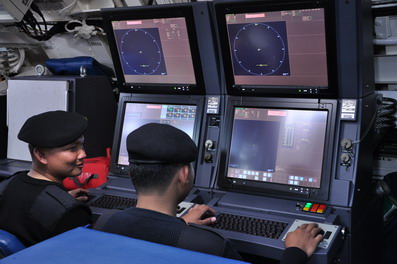
Combat Management System MSI-90U MK2 buatan Kongberg Norwegia (photo : Armatim)


Dalam uji coba penembakan itu bertujuan untuk mengetahui sejauhmana kemampuan integrasi antara Combat Management System (CMS) type Multi Sensor Integrited (MSI) 90U MK2 dengan Torpedo SUT DM264 Mod 0 buatan Kongsberg Defence and Aerospace Norwegia. Yang mana sistem CMS MSI tersebut merupakan pengganti sistem lama yaitu CMS jenis Sinbads. Penembakan ini sekaligus untuk menguji alat pengganti terebut apakah dapat berfungsi  sesuai dengan yang diharapkan.

Unsur yang tergabung dalam Satuan Tugas (Satgas) Penembakan Torpedo SUT Kepala Latihan tahun 2012, terdiri dari KRI Sultan Iskandar Muda-367, KRI Hiu-804, KRI Soputan-921, 2 Sea Rder, 2 Perahu Karet (PK), 1 Tim Komando Pasukan Katak (Kopaska) Koarmatim, 1 Tim Penelam dari Dinas Penyelamatan Bawah Air (Dislambair) Koarmatim, Laboratorium Induk Elektronika (Labinlek) Mabesal dan Arsenal serta Diskes koarmatim.

ATLAS ELEKTRONIK Sets New Range Record for Torpedoes

19 Mei 2012

SeaHake® mod4 ER: modernized DM 2 A4 with range of more than 140 km (photo : Atlas Elektronik)


Bremen – ATLAS ELEKTRONIK has increased the reach of its torpedoes substantially, setting a new range record for torpedoes. At a test-firing in March 2012, the heavyweight torpedo SeaHake® mod4 ER (Extended Range) achieved a range of over 140 kilometres. SeaHake® mod 4 is the latest advancement of the DM 2 A4 heavyweight torpedo, which is in service with the German Navy as well as the navies of Turkey, Pakistan and Spain. By fully exploiting the system’s unique propulsion and battery technology, it became possible to surpass the maximum ranges usual for modern heavyweight torpedoes in the global market by considerably more than 50%.

“With this record, ATLAS ELEKTRONIK has set a new benchmark in torpedo technology. Until now, such ranges were hardly even conceivable. We are very proud to have made such a significant advance in torpedo technology, thus giving our customers new possibilities for sea defence,” said Kai Pelzer, Executive Director Naval Weapons at ATLAS ELEKTRONIK.


The new version of the SeaHake® mod4 is also fitted with innovative navigation and communications technology, enabling extremely precise navigation and control of the torpedo over the entire distance. The SeaHake® mod4 ER can be deployed from seagoing platforms as well as from special land-based platforms.

The sea trials took place in cooperation with the German Armed Forces Technical Centre for Ships and Naval Weapons in the Eckernförde Bay.

Terma and DCNS have Developed a Fully Automatic Anti-Torpedo Decoy System

24 September 2011

A fully automatic decoy system will protect ships against torpedoes attacks (image : Defpro)

At the Defense & Security Equipment International exhibition Terma and DCNS announced that their technical cooperation has resulted in an important improvement for ships with a need for protection against torpedoes.

Terma and DCNS have developed a fully automatic anti-torpedo decoy system.

The system uses the Terma 130mm Soft Kill Weapon System (SKWS) to fire DCNS CANTO-V anti-torpedo decoy. The SKWS upgrade for twin AAW and ASW purpose use the jointly developed software with advanced algorithm (embedding DCNS CONTRALTO-V reaction software) to support fully automatic firing. This provides the ship with an effective protection against torpedoes attacks. The decoys will be placed in the water in the best way to confuse the torpedo together with ship evasive manoeuvres proposal.

With advanced algorithms, this system will provide the best firing solution and protection of all types of ships against torpedo attack.

(DCNS)

Baca Juga :

Terma SKWS Decoy Launching System

Terma SKWS decoy launchers (photo : Terma)

The anti-ship missile threats continue to increase and evolve. New missiles are faster, stealthier, more manoeuvrable, and increasingly more intelligent with regard to target discriminationand electronic counter-countermeasure functionality, adevelopment leaving recent generations of hard- and soft kill systems less effective.

The use of hard-kill is further limited with the increasing peacekeeping and controlling activities in littoral waters where the release of weapons frequently is bound by strict engagement rules, but also requiring fast reaction time calling for a high degree of automation. In this situation, soft-kill i.e. decoysystems, have come to be seen as the non-aggressive self defence solution, a weapon of least regret.

Decoy systems are today fitted to all naval war vessels rangingfrom fast attack crafts, mine warfare vessels, frigates to evenbigger units as LPD’s as a key element in their electronic warfare suites. Integrated with the ship EW and Radar sensor assets the decoy system will provide fast and intelligent firing of all types ofoff-board decoys.

For high value and larger units, the advent of Active Offboard decoys provide improved defence. A further extension of thedecoy launching system is to fire acoustic decoys as part of theship’s torpedo defence suite.

The Terma SKWS Decoy Launching System is designed to fulfil allthese requirements.

Terma SKWS is a modern decoy launching system that can fire all existing 130 mm decoys – also known as SeaGnat decoys. The system is based on two Terma DL-6T launchers for small vesselsor two Terma DL-12T launchers for larger vessels, one for port andone for starboard mounting. The system may be expanded tocontrol up to 24 firing tubes on each side of the ship. The Terma launcher is designed to provide 360 degrees coverage against attacking anti ship missiles. This is obtained by carefully positioning a decoy from one of the multi-angular launchers.

The key system features include:
- Lightweight launchers with small footprint
- Low pressure deck mounts
- Effective 360° horizontal coverage
- Advanced launch algorithms
- Fully automated operation
- Support of all SeaGnat type decoys
- Support of SIREN Active Jammer Decoy
- High flexibility and easy integration of user defined algorithms and libraries

The 130 mm decoy ammunition is supported throughout NATO and around the world with more than 500 systems in service. The high number of systems in service has promoted a continuous development of decoys from different and competing sources. Currently the following types of decoys are available and supported by Terma SKWS:

- Seduction Chaff: SeaGnat 214
- Distraction/Confusion Chaff: SeaGnat 216 / PW216
- Infrared Rounds: PIRATE / GIANT (MK245 and DM19A1) / TALOS
- Dual Mode (RF and IR) decoys: Chimera and Bullfighter
- Offboard Active Decoy: SIREN
- Torpedo Decoys: LEAD MK12, MK13, MK14, MK15, and LESCUT

For full support of:
- SIREN Active Offboard Decoy
- PW 216 Distraction Chaff with automatic range programming an upgrade kit needs to be installed.

(Terma)

Australian DoD Response to Criticisms of MU90 Torpedo Project

26 Agustus 2011


MU-90 lightweight torpedo (photo : Eurotorp)


An article in some Fairfax media papers today (Lost for words, a Navy all at sea, 26 August 2011) and more widely reported in the electronic media contains information that is wrong in fact and misleading.


The article refers to the need to translate technical documents and instructions for the MU90 Light Weight Torpedo into English.


This is not correct.


As a condition of contract all key project documentation including technical instructions from the supplier has been delivered in English.


The MU90 torpedo is a complex anti-submarine warfare weapon and is a joint French and Italian development.


Defence is taking advantage of additional test data from these countries as a way to reduce costs and minimise the number of formal ship trials for the Australian MU90 program to finalise the acceptance into ADF service process.


Torpedo trials are very expensive and each test firing is a significant exercise in its own right. Being able to examine and use the results of other countries’ trials saves the Australian taxpayer a lot of money.


To date the French and Italian Navy testing programs have involved the firing of over 200 MU90 torpedoes. It is the reports and data from these tests - conducted by the French and Italian Navy for their own purposes and provided to Australia - that is in French and Italian and needs to be translated into English.


As a Project of Concern the MU90 Light Weight Torpedo replacement project receives Government, Defence and equipment supplier oversight.


(Aus DoD)

Australia Requests Sale of 200 MK-54 Lightweight Torpedoes

06 Oktober 2010


Mk-54 lightweight torpedoes (photo : Defense Industry Daily)


WASHINGTON, – The Defense Security Cooperation Agency notified Congress today of a possible Foreign Military Sale to the Government of Australia of up to 200 MK 54 All-Up-Round Torpedoes, 179 MK 54 Flight in Air Material Kits, 10 MK 54 Exercise Sections, 10 MK 54 Exercise Fuel Tanks, 10 MK 54 Dummy Torpedoes and 6 MK 54 Ground Handling Torpedoes. The estimated cost is $169 million.


The Government of Australia has requested a possible sale of up to 200 MK 54 All-Up-Round Torpedoes, 179 MK 54 Flight in Air Material Kits, 10 MK 54 Exercise Sections, 10 MK 54 Exercise Fuel Tanks, 10 MK 54 Dummy Torpedoes, 6 MK 54 Ground Handling Torpedoes, support and test equipment to upgrade Intermediate Maintenance Activity to MK 54 capability, spare and repair parts, technical data and publications, personnel training and training equipment, U.S. government and contractor engineering, technical and logistics support services, and other related elements of logistics support.


Australia, one of our most important allies in the Western Pacific, contributes significantly to ensuring peace and economic stability in the region. Australia’s efforts in peacekeeping and humanitarian operations in Iraq and in Afghanistan have served U.S. national security interests.


Australia intends to use the MK 54 torpedo on the Lockheed/Sikorsky MH-60R helicopter. Australia has significant experience with modern weapons systems, particularly the MK 46 Mod 5 (SW) torpedo. The MK 54 torpedo is an upgrade of the MK 46 torpedo.


The proposed sale of this equipment and support will not alter the basic military balance in the region.


The prime contractor will be Raytheon Integrated Defense Systems in Tewksbury, Massachusetts. There are no known offset agreements proposed in connection with this potential sale.


Implementation of this proposed sale will not require the assignment of U.S. Government or contractor representatives to Australia.


There will be no adverse impact on U.S. defense readiness as a result of this proposed sale. This notice of a potential sale is required by law and does not mean the sale has been concluded.


(DSCA)

ANAO Audit of Lightweight Torpedo Replacement Project

20 Mei 2010

MU-90, the RAN's lighweight torpedo (photo : wielingen1991)

John Faulkner, Minister for Defence, and Greg Combet, Minister for Defence Material and Science, today welcomed the release of the Australian National Audit Office (ANAO) report into the Lightweight Torpedo Replacement Project.

“The ANAO report clearly demonstrates that there have been - and remain - significant and serious problems associated with the development and procurement of the Lightweight Torpedo under Project JP 2070,” Senator Faulkner said.

“I frankly acknowledge that the management of this project and capability has simply not been good enough.”

Mr Combet said Defence had accepted the report and all of its recommendations.

“The project has been a complex undertaking and has a long history of project management difficulties and failures,” Mr Combet said.
”It is clear that the project, first approved 12 years ago, should have been better defined, costed and managed.”

Since 2008, the Government has taken the following actions to remediate this project:

Placing the Project on the Government’s new ‘Projects of Concern’ list. This allowed for a significant increase in the level of Government and senior management oversight of the project, and monthly reports of the project being delivered to Government.

Creating the Explosive Ordnance Division within the Defence Materiel Organisation (DMO) in February 2008 to provide a dedicated and increased focus and management of explosive ordnance project and sustainment activities.

Cancelling the air integration of the Lightweight Torpedo in mid 2009 due to ongoing concerns about its successful achievement.

Senator Faulkner said these actions have not been sufficient to fully address the problems with this project.

“Accordingly, I have asked the Secretary, the Chief of the Defence Force and the Chief Executive Officer of the DMO to report to Ministers every two months on the progress of this project. We believe we can get this project back on track, but this will take some time and a lot of hard work,” Senator Faulkner said.

“In order to promote increased transparency of this project I recently wrote to the Auditor General to request that he conduct a follow up review on the Project in twelve to eighteen months time, to provide an external assessment of its progress.”

Mr Combet said the ANAO report demonstrated the critical importance of the Government’s program to reform defence procurement.

“Since coming to power the Government has crafted a comprehensive program of defence procurement reforms which are designed to avoid issues such as those raised in today’s Audit Report,” Mr Combet said.

(Australian DoD)

South Korea Starts Red Shark Torpedo Production

26 August 2009

Red Shark is a long-range ship-to-submarine light torpedoes that can travel about 20 kilometers in the air before dropping into waters to track and destroy targets. (image : Militaryphotos)

South Korea has begun production of 70 Hongsangeo anti-submarine light torpedoes (Red Sharks) for use on some of its newest destroyers.

Scheduled for deployment between 2010 and 2012, the 18ft, two-stage Red Shark torpedoes are long-range ship-to-submarine light torpedoes that will be operated aboard the korean Navy's latest Gwangaeto the Great Class (KDX- I) and Chunmugong Yi Sunshin Class (KDX- II) destroyers.
Red Shark torpedoes ship-based vertical launch systems (photo : Militaryphotos)

South Korea's Agency for Defence Development (ADD) said South Korean missile manufacturer LIG Nex1 co-developed the torpedo with the ADD at a cost of about $80m.

Red Shark (=Hongsangeo) - a Korean ASROC (photo : Atwiki)

The precision-guided torpedoes are launched vertically and can fly for about 12 miles before submersing into the sea to track and destroy targets.

The country is investing about $145m in the torpedoe manufacture and will increase production in 2013.

Blue Shark - a light torpedoes of Shark series (photo : Atwiki)

In addition, the ADD and LIG Nex1 have cooperated to develop Shark series torpedoes which include Blue Shark (a light torpedo) and White Shark (a heavy torpedo).

The Red Shark torpedoes underwent nine years of development and completed the final tests in early 2009.

(Naval Technology)

Torpedo Mk-48 for Australia

1 Agustus 2006

Loading a Mk-48 torpedo (photo : DevGovAu)

Raytheon Systems Co., Integrated Defense Systems, Keyport, Keyport, Wash., is being awarded a $5,087,815 firm-fixed-price modification to previously awarded contract (N00024-04-C-6101) to satisfy additional fiscal year 2006 Navy and Royal Australian Navy requirements for MK48 advanced capability and MK54 Mod 6 lightweight torpedo spares and MK48 common broadband advanced sonar system Mod 7 heavyweight production engineering support.

The primary purpose of this contract modification is to purchase additional spares and issue a technical issue to support fleet operational requirements for the various torpedo product lines. This modification combines requirements for the Navy (99 percent) and the Royal Australian Navy (1 percent). Work will be performed in Keyport, Wash. (90 percent), and Portsmouth, R.I. (10 percent), and is expected to be completed by June 2009. Contract funds will not expire at the end of the current fiscal year. The Naval Sea Systems Command, Washington, D.C., is the contracting activity.